Building 1,314 Shopify collection pages from catalogue data
How Rendezvous Cinema got a page for every film director it stocks, matched from an open film database, kept in stock nightly and never left empty.
1,314 director pages built from the catalogue, 18 to 20 October 2026
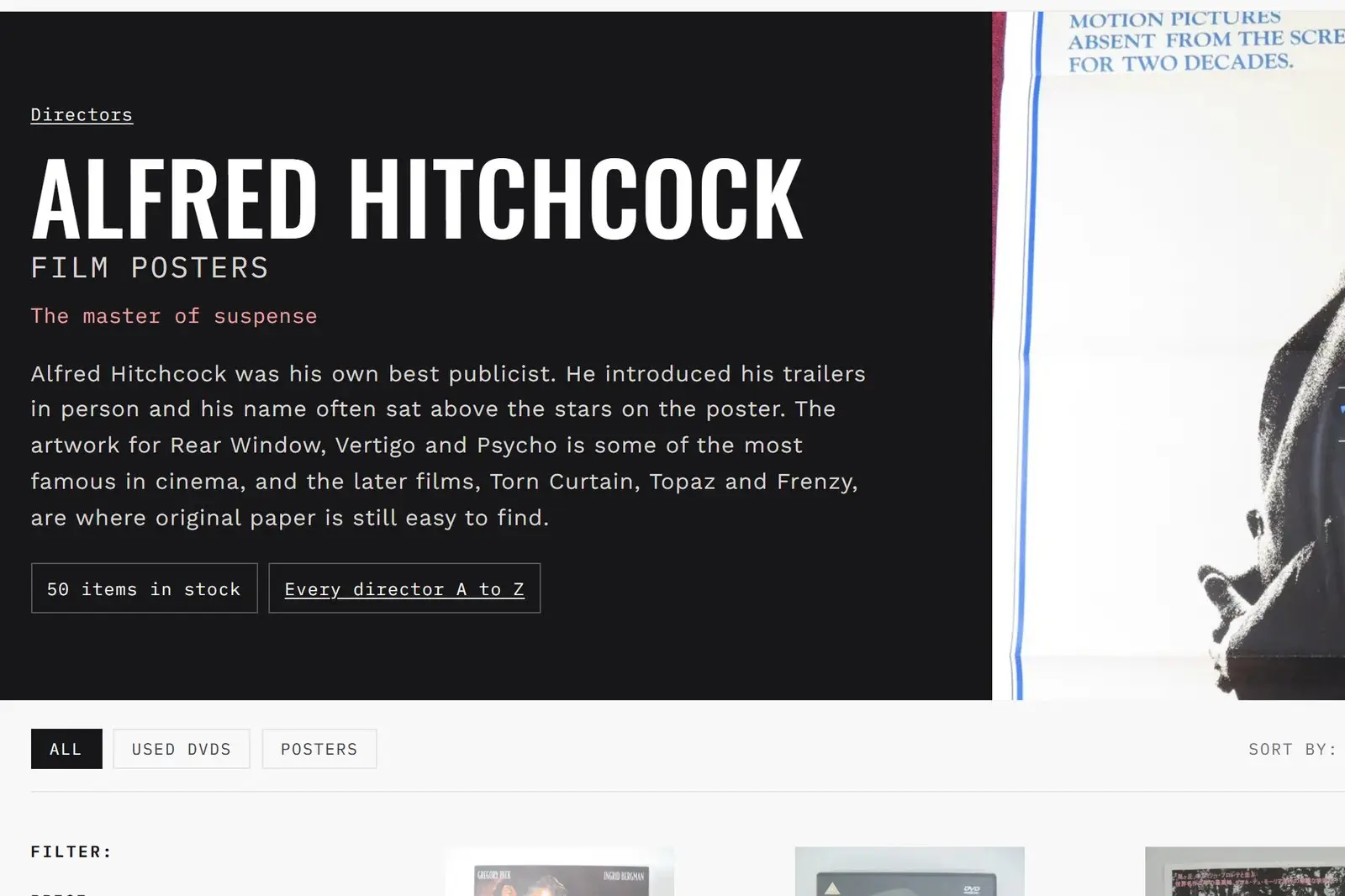
People who collect film posters search by director. “Hitchcock posters”, “Kubrick original poster”, “Ken Loach lobby cards”. Rendezvous Cinema had thousands of posters for those directors and no page that answered any of those searches. The posters were there; the page Google could show was not.
Writing a page by hand for every director was never going to happen. Between 18 and 20 October, 1,314 of them went live, built from data the shop already had.
Step one: know who directed what
A poster listing says “Vertigo, 1958, US one sheet”. It does not say Alfred Hitchcock. So every listing was matched to TMDb, an open film database, which does.
Matching 30,000 posters to the right film is harder than it sounds. Titles repeat, remakes share names, and foreign posters carry foreign titles. The rule was strict: a match only counts as confirmed when the listing itself proves it, for example by naming the director or the stars somewhere in its own text, or by matching both the title and the year.
- 18,238 different films, found with about 112,200 lookups.
- In a 500-item sample, 87% confirmed themselves; 75 of those were checked by eye, and all 75 were right.
- Across the catalogue, 88% confirmed. The rest go to a review screen, never straight to the shop.
- Television is left out on purpose: the “directors” of a series in that database are its creators, which would put the wrong name on the poster.
30,136 products were then tagged with their director.
Step two: a page per director, but only where it is worth one
Each page is a Shopify smart collection: every product tagged with that director, in stock. The page title reads “[Name] film posters”, which is what people search.
A page with two posters on it is worse than no page at all, to a customer and to Google. So a director only got a page with enough behind it. The first batches needed at least ten posters in stock. The last batch, at six and above, also needed at least two different films, a poster that crops well for the top of the page, and no near-duplicate of a director already listed. That left out 38 directors with only one film, 29 with no usable poster and 21 near-duplicates.
There is also an A to Z of every director at one address, so a collector can browse rather than search.
Step three: keep it true every night
A shop that sells original posters sells them one at a time. Pages built once go stale within a week. So a job runs every night and:
- rebuilds the A to Z, sorted by surname, and refuses to publish if the new list is empty or less than half the old one, because that means something upstream broke;
- replaces the picture at the top of any page whose poster has sold, choosing a format that crops well, at most ten a night.
That job had a bug worth sharing. On its first morning it ran every five minutes instead of once, 68 times, because it decided whether it had run by checking when the page was last updated. Shopify does not change a page’s “last updated” time when you save it without changing anything, so the job never saw its own work. Anything that checks “has this changed?” in Shopify should compare the content, not the timestamp.
Never delete a page
When a director’s posters have all sold, the page stays. It says everything has sold and more is coming, with a search for that director, links to the others, and the newest posters in. The A to Z leaves it out until there is stock again.
This was a deliberate decision. A page Google has found and ranked is worth keeping, and a deleted page leaves a dead link wherever anyone shared it. The next poster for that director will come in, and the page will be there waiting for it.
Wrong matches
Some matches will be wrong, however strict the rule. They are listed for the shop’s team rather than fixed automatically, and fixing a film in Overlook’s review screen re-tags every poster for it, so the pages correct themselves.
What it changed
The pages went live between 18 and 20 October 2026. Google takes time to find and rank 1,314 new pages, so there is nothing fair to measure yet, and I will not guess. I will add the Search Console figures here when there is.
Doing this for your own shop
Most shops already hold the data for pages like these: a brand, an author, a maker, a designer, a material. If people search by it and you do not have a page for it, that is traffic going to whoever does. Before you build them, decide three things: the minimum stock a page needs, what a page shows when it sells out, and what checks it every night. Those three decide whether the pages help or become 1,300 thin pages Google learns to ignore.
If this sounds like your shop, a twenty minute call will tell us both whether it is worth fixing.
More like this in the articles, or see what technical seo involves.