Why Shopify search shows the wrong results, and how I fixed it
Shopify pads search results with near spellings, so a search for a film it had no copy of showed 93 others. How the search now tells the truth.
93 results for "the departed", and none of them was The Departed, October 2026
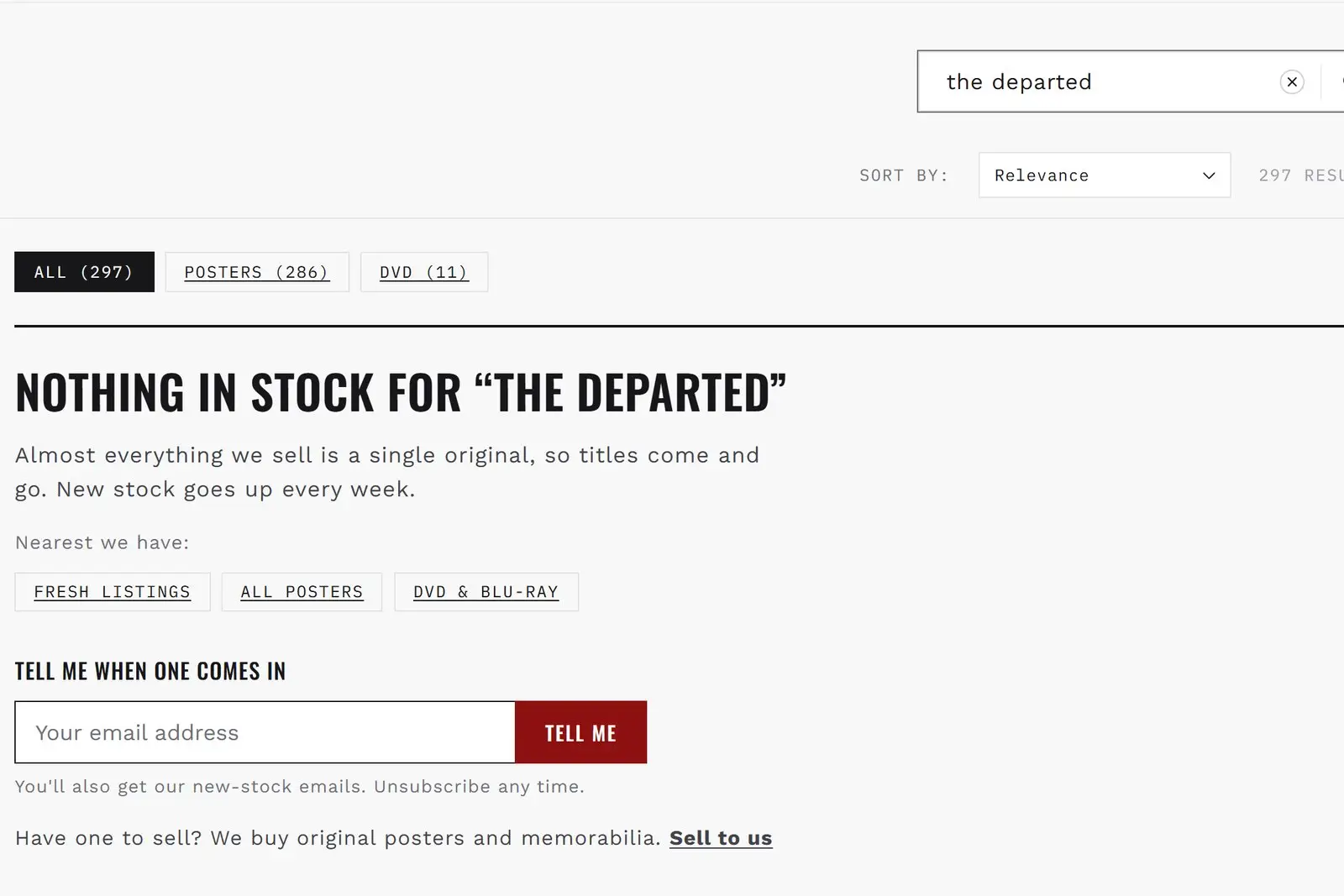
Someone searched Rendezvous Cinema’s shop for “the departed”. Shopify showed them 93 results. None of them was The Departed.
Rendezvous sells around 30,000 original film posters and discs. When a search finds nothing, the honest answer is “we have none in stock, here is what we do have”. What Shopify does instead is pad the results with anything that shares a word or a near spelling, so the customer scrolls through 93 posters for other films and leaves thinking the site’s search is broken. It is, a little.
What Shopify search actually does
Shopify’s built-in search matches loosely. Every film with “the” in the title has a claim on “the departed”. It also stops counting at about a thousand: a search for “poster” fills 42 pages and the 43rd is empty, though nearly 29,000 products have “poster” in the title. And it treats hyphens as spaces, so “wall-e” matched everything containing “wall” or “e”.
You cannot change how Shopify ranks results without a search app. You can change what the page says about them.
Judging the results honestly
The theme now checks the first page of results itself. A title counts as a real match when it contains the search as typed, ignoring punctuation and spaces, or contains every word of two letters or more. A hyphenated search has to appear with its hyphen, because “wall-e” is not someone called Walle.
It only judges page one with no filters ticked. Before building it that way, I checked 17 live searches page by page: whenever page one held only a few real matches, no real match ever turned up on a later page.
The page then says what it found, plainly:
- Nothing real: “Nothing in stock for the departed”, then the nearest stock, a “tell me when one comes in” button, and a link to sell them one.
- A few real matches: “4 matches for…”, with those four first, not buried at number 61 of 93.
- A lot: counts over a thousand read “1,000+” instead of a number Shopify cannot vouch for.
Learning what people cannot find
A search that finds nothing is a customer telling you what to stock. So those searches are now recorded.
When page one has eight or fewer real matches, the page sends the search and its match count to Overlook, the system that runs Rendezvous’ listings. To count distinct people rather than repeated searches, it keeps a salted fingerprint of the visitor’s address, never the address itself. No cookie, nothing stored in the browser, and records are deleted after 90 days. Bots and anything over 60 reports an hour from one source are dropped.
Turning “nothing found” into “try these”
Every night, a job takes the most searched terms that found little and looks each one up on TMDb, an open film database. For “the departed” it finds the director, the cast, the studio and the franchise, then counts what Rendezvous actually has in stock for each: Scorsese 11, DiCaprio 49, Damon 74, Nicholson 81.
The next person to search “the departed” sees those links instead of a dead end. Each kind of link needs enough stock behind it to be worth the click: at least three posters for a director, five for an actor. There is a review page where the team can edit or hide any suggestion before or after it goes up.
What it changed
It is early. The honest search went live on 15 October 2026, and there are not yet enough logged searches to say what it has done to sales, so I will not claim anything. I will add figures when there is a fair period to measure.
What it has already done is change what a customer sees when the shop does not have what they want: a straight answer and a way forward, instead of 93 wrong posters.
Checking your own shop
Search your own store for five products you know you do not stock. If the results page shows a full page of other things with no hint that the real item is missing, your customers are getting the same experience. The fix does not need a search app. It needs the page to look at its own results before it shows them.
If this sounds like your shop, a twenty minute call will tell us both whether it is worth fixing.
More like this in the articles, or see what shopify development involves.